Showing posts with label ITC Maurya Delhi. Show all posts

Monday, September 14, 2015

Wine Masterclass by Bill Hardy

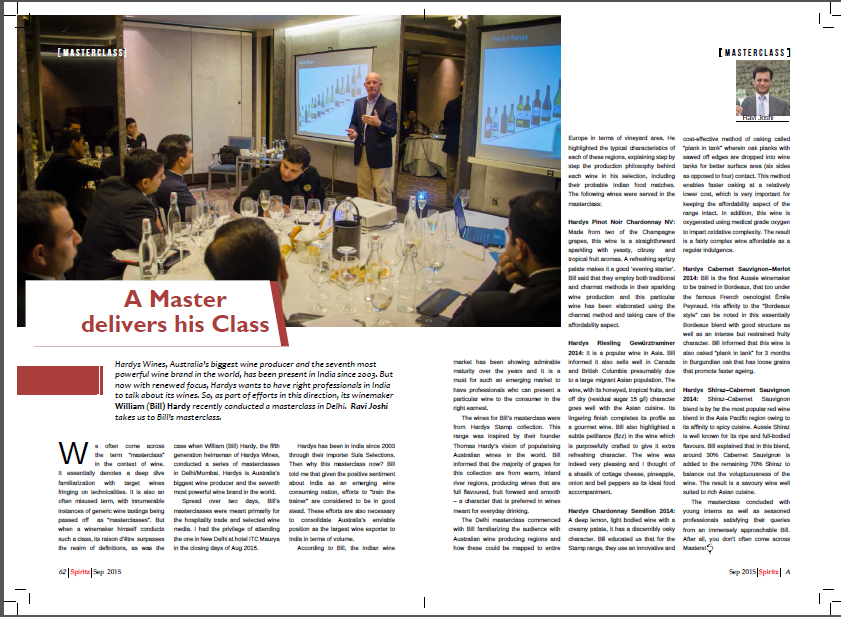
Masterclass” is a term we often come across in today’s wine world. It essentially denotes a deep dive familiarization with target wines, fringing on technicalities. It is also an often misused term , with innumerable instances of generic wine tastings being passed off  as “masterclasses”. But when a winemaker himself conducts such a class, its raison d’être  surpasses the realm of definitions, as was the case when William (Bill) Hardy- the fifth generation helmsman of Australia’s biggest winemaker Hardys Wines conducted a series of masterclasses in Delhi/Mumbai. Spread over two days, these masterclasses were meant primarily for the hospitality trade and selected wine media. I had the privilege of attending the one in New Delhi  at hotel ITC Maurya in the closing days of Aug 15.


Bill Hardy conducting his Masterclass in New Delhi
(Pic: Sula Selections)
Hardys has been in India since the year 2003 through their importer Sula Selections. Then why this
masterclass now? Bill Hardy told me that given the positive sentiment about India as an emerging wine consuming nation, efforts to “train the trainer” are considered to be in good stead. These efforts are also necessary to  consolidate Australia’s enviable position as the largest wine exporter to India in terms of volume. According to him, the Indian wine market has been showing admirable maturity over the years and it is a must for such an emerging market to have professionals who can present a particular wine to the consumer in the right earnest.

The wines for the masterclass were from Hardys Stamp collection. Bill brought out that this range was inspired by their founder Thomas Hardy’s vision of popularizing Australian wines in the world. He highlighted that the majority of grapes for this collection are from warm, inland river regions, producing wines that are full flavoured, fruit forward and smooth- a character  preferred in everyday drinking wines.


(Pic: Sula Selections)

The Delhi masterclass commenced with Bill familiarizing the audience with Australian wine producing regions and how these could be mapped to entire Europe in terms of vineyard area. He highlighted the typical characteristics of each of these regions, explaining step by step the production philosophy behind each of his presented wines, including their probable Indian food matches. The session progressed with the wines served as under:


(Pic: Sula Selections)

Hardys Pinot Noir Chardonnay NV

Made from two of the Champagne grapes, this wine is a straightforward sparkling with yeasty, citrusy  and tropical fruit aromas. A refreshing spritzy palate makes it a good ‘evening starter’. Bill said that they employ both traditional and charmat methods in their sparkling wine production and this particular wine has been elaborated by using the charmat method, keeping in line with its affordability aspect.

Hardys Riesling Gewürztraminer 2014

A  popular wine in Asia, Bill informed that their Riesling-Gewürztraminer also sells well in Canada and British Columbia presumably due to a large migrant Asian population. The wine, with its honeyed, tropical fruits, and off dry (residual sugar 15 g/l) character is quite well suited to Asian cuisine. It’s lingering finish completes its profile as a gourmet wine. In addition Bill highlighted a subtle petillance (fizz) in the wine which is purposefully crafted to give it an extra refreshing character.The wine was indeed very pleasing and I thought of a shaslik of cottage cheese, pineapple, onion and bell peppers as its ideal food accompaniment.

Hardys Chardonnay Semillon 2014

A deep lemon, light bodied wine with a creamy palate and a discernibly oaky character. Bill educated us that for the Stamp range, they use an innovative and cost effective method of oaking called “plank in tank” wherein oak planks with sawed off edges are dropped into wine tanks for better surface area (six sides as opposed to four) contact. This method enables faster oaking at a relatively lower cost, which is very important for keeping the affordability aspect of the range intact. In addition, this wine is oxygenated using medical grade oxygen to impart oxidative complexity. The result is a fairly complex wine affordable as a regular indulgence.

Hardys Cabernet Sauvignon- Merlot 2014

Bill Hardy is the first Aussie winemaker to be trained in Bordeaux, that too under the famous French oenologist Émile Peynaud. His affinity to the “Bordeaux style” can be noted in this essentially Bordeaux blend with good structure as well as an intense but restrained fruity character. Bill informed that this wine is also oaked “plank in tank” for 3 months in Burgundian oak that has loose grains that promote faster ageing.

Hardys Shiraz-Cabernet Sauvignon 2014

Shiraz- Cabernet Sauvignon blend is by far the most popular red wine blend in Asia Pacific region owing to its affinity to spicy cuisine. Aussie Shiraz  is  well known for its ripe and full bodied flavours. Bill explained that in this blend, around 30% Cabernet Sauvignon is added to  the remaining 70 % Shiraz in to balance out the voluptuousness of the wine. The result is a savoury wine well suited to rich Asian cuisine.

The masterclass concluded with young interns as well as seasoned professionals satisfying their queries from an immensely approachable Bill.

After all you don’t  come across Masters so often! Do you?

One for posterity: Bill Hardy with the Masterclass attendees  (Pic: Sula Selections)


This post has also been published by Spiritz Magazine in their Sep 15 issue

Thursday, August 13, 2015

Tasting Janus- the first 100% Grape Brandy from India

Last week ended on a heady note for me. As I received a call from Prarrthona Pal Chowdhury, Head Marketing, Brandy Project & International Brands  at Sula Vineyards proposing a private tasting of Janus- their recently launched premium brandy- I  agreed on it despite the short notice. Having already read about the Mumbai tastings of the brandy, I was eager to taste  it at the earliest, and here was a ready opportunity.

But why was I so keen to taste an Indian brandy after having experienced many international brands of repute? Simply because Janus happens to be the first 100% grape brandy produced in India. Then what exactly are the rest? For that let us first try to understand brandy in the right perspective.

What is a brandy?


The word  “brandy” originated from "brandewijn" - a Dutch term for burnt wine. In olden days when wine was being transported in barrels through the tardy sea route, there were frequent cases of spoilage owing to climatic variations and uncontrolled storage conditions. A workaround to this problem saw wine being distilled, dramatically improving the shelf life of this “burnt wine”, which was then consumed at the destination diluted with water.

But there is more to brandy than just “burning” wine. Evidence of its use in medicine over the centuries is aplenty. It has since then evolved as a refined alcoholic beverage, largely revolving around two aspects- Geographic Indication and Oak Ageing. Hence we know Cognac, Armagnac and other fine brandies the way they are.

The Brandy classification however applies to any fruit originated spirit and not just grapes. Hence we have Calvados (an apple brandy), Poire Williams (a pear brandy) and so on. But grape brandy has been most prevalent with its recognized high antioxidant and  remedial properties. Probably the reason why the French coined the special term Eau de vie meaning "water of life" for this elixir.

Given this background, it becomes imperative that when we buy a brandy for its virtues, it should  be a 100% grape spirit rather than a blend of other distillates. In the Indian context (also in majority of Asian region) the latter is quite common with even grain based spirits finding their way inside the blend . Hence the arrival of a home grown 100% grape brandy  as Janus has come as a welcome development for connoisseurs of fine beverages in India.

The Blind Tasting


My tasting experience at Prarrthona’s behest involved  three samples poured out of non descript bottles with a simple premise- to discern the smoothest one and to guess which one could probably be Janus. The “simple” agenda though, had more to it as she further told me that samples other than Janus could be anything- whisky, rum, or another brandy.  The task looked uphill but I decided to be patient and go over the samples in three iterations as follows:


  • Ruling out by exception.
  • Identifying typical traits of each sample.
  • Confirming my findings through a rerun.
The tasting sitting with Prarrthona Pal Chowdhury at ITC Maurya (Pics: Prarrthona Pal Chowdhury)
Here is how it went (my inferences shown in parentheses):

Iteration # 1 : Colour and Aromas only.

Sample 1: Light coloured with unmistakable malt notes amongst others. (most probably a whisky).
Sample 2: Glowing amber colour, a honeyed nose accompanied by  citrus fruit aromas (undecided).
Sample 3: Deep gold with peaty nose (a scotch whisky for sure).

Iteration # 2 Aromas and Palate.

Sample 1: Malt notes confirmed with floral and sherry notes. (reasonably sure about whisky).
Sample 2: Sweet spice and floral notes with the smoothest finish of all (betting heavy on brandy)
Sample 3: Deep gold with peaty nose. Rich flavours but not so smooth (a whisky for sure)

Iteration # 3 Confirmation.

Sample 1: Earlier observations confirmed. (This is a whisky).
Sample 2: Most likely this is Janus.
Sample 3: Definitely a whisky.

As I conveyed my opinion to Prarrthona, she was delighted the same way as I was. For her, it was the vindication of confidence in her brand which she had so boldly pitted against other reputed ones. For me, it was a reassurance of my primal senses related to beverages appreciation.

Having known which one was Janus, I could now dwell  leisurely to analyse it as a brandy. I found that apart from the smoothness it had a refined feel that was inclined towards the Cognac style replete with a full body and a fruity and spicy character.


Prarrthona told me that the Cognac orientation of Janus was a given since the product had started as a collaboration between Remy Cointreau and Sula. With the exit of Remy Cointreau from India as a business rehash and  selling of their assets (including brandy stocks and equipment) to the Indian winemaker, Janus continues to be produced using the same equipment (pot stills, limousine oak barrels etc)  that was specially  imported from Remy’s facility in France. French Master Blender, Yonael Bernard  has purposefully created a smooth and distinctive blend that carries the Cognac character with aplomb.

Currently Janus is available in Goa at ₹ 1500.00 / ₹ 395.00  for a 750 ml  / 180 ml bottle. I am told that it will soon to be launched in Mumbai, Delhi and Bangalore followed by other cities pan India. 

But isn’t it a marketing challenge to convince the average Indian consumer to buy a significantly higher priced brandy when there are lesser “brandies” that sell at nearly half the price? Prarrthona tells me that they see Janus as having no competition in the current brandy market owing to its entirely different niche. However, she acknowledges that they will have to conduct awareness campaigns to educate the consumer on this aspect.

In the meantime, I seem to have found a perfect local companion for my “Sidecar”.


Tuesday, May 21, 2013

Rendez-vous Cattier- Encore!


Wines for the Evening
Pervasive luxury has to be the norm when a glitzy and glamorous Champagne House does a national level launch of its beauties. We are talking of Cattier- the famous Champagne house, that was recently in news when guests of famous Hollywood actor Leonardo di Caprio swirled and sipped  $ 3.5 million worth of its prestige cuvée Armand de Brignac at his birthday celebrations. The occasion this time however, was the India launch of Cattier held in New Delhi at Hotel ITC Maurya and came as a precursive cooler to the already soaring mercury in the Indian capital.

M. Jean-Jacques Cattier introducing the wines
Cattier is a family owned Champagne house that has owned vineyards in the exclusive Montagne de Reims area of Champagne since 1763. 1918 onwards, the house started producing Champagne under its own family name and currently exports to more than 60 countries worldwide (India being the latest). The wine styles range from crisp and minerally Blanc de Blancs (white wine from white grapes) to elegantly structured Rosés, and firm yet sophisticated Blanc de Noirs (white wine from black grapes) . I was disappointed though, to discover from Philippe that for the time being, Armand de Brignac would elude the Indian shores due to current market dynamics as envisaged by their importers- the Sri Lanka based Kosmos Group. Hope the viability is pretty soon!

Hors d'ouvres


My association with the Champagne house started last autumn when I went visiting them at Chigny les Roses in the very heart of Champagne district between Reims and Epernay. A visit to their three floors deep cellars and a dégustation session with none other than their President Monsieur Jean-Jacques Cattier was an  experience (read my earlier blogpost on Maison Cattier) that I started cherishing already.  So when I received an email from M Philippe Bienvenu,  Commercial Director Cattier, inviting me rather modestly for ‘a flute of Champagne’ to celebrate the launch of Cattier wines in India, my anticipation started building up. Needless to mention, the celebrations went miles ahead of a simple flute!
It  was deja vu to find M Cattier and Philippe warmly welcoming guests at the venue, even as the evening began with rounds of aperitif and hors d’oeuvres indicating the gourmet fare that lay ahead. Around an hour of tête-à-tête later, the dinner doors were opened and revealed
The Bubbly starts pouring!
immaculately laid out tables ready to receive the five course fare and the guests partaking of it. The selective gathering comprised of well heeled wine lovers from different vocations and it showcased the producer’s seriousness for reaching out to the widest possible cross-section of the Indian market.
Course by course, the experience unfolded as follows (since I opted for non-vegetarian cuisine, my apologies to vegetarians for skipping the detailed description and photos of veg dishes):

First Course (Entrée)


Wine: Cattier Brut Vinotheque

Type: Vintage 2005
Blend: 1/3rd each Pinot Noir, Pinot Meunier and Chardonnay
Alcohol Content: 12.5%
Approx Retail price in Delhi: Rs. 4500.00

Vinotheque in French means “Library of Wines”. As I discussed this aspect with Philippe, he told me the significance of the name being in the exotic and collectible nature of the wine that is akin to storing in a library, only to be pulled out for use when the situation is apt- to say so- with the compatible mood, food and of course the ambience!


Accompanied Food:


Vegetarian : Summer mushroom fondue drizzled with white truffle oil and butter fried
goujons in  chive oil.

Non Vegetarian: Olive oil poached Scampi masked in raw Mango confit, paired with Sevruga caviar, port poached figs.

Tasting Notes: Clear pale gold colour with shimmering reflections. Aromas of golden apple, lemon and brioche. Refreshing acidity and layered complexity on the palate. Worked well with the freshness of Scampi, the tanginess of Mango confit and the salty palate coating texture of the Sevruga caviar.

Second Course

Wine: Cattier Brut Vinotheque


Accompanied Food:

Vegetarian: White corn agnolotti tossed in curry emulsion with beetroot essence.

Non Vegetarian: Chilean Sea bass napped in fennel confit, served with a side of fennel dill crescents and mustard butter.

Tasting Notes: As above. The wine complemented the freshness of Sea bass and balanced the aromatic complexity of the dish. And yes, the creamy texture of the dish found a great companion in the refreshing acidity of the wine.

Palate Cleanser

Green Apple Armagnac Sorbet- Served in an alloy spoon atop crushed ice in a cocktail glass.
Worked well to demagnetise the palate.

Third Course

Wine: Cattier Brut Blanc de Noirs

Type: Non Vintage
Blend: 70 % Pinot Noir, 30 % Pinot Meunier
Alcohol Content: 12.5%
Approx Retail price in Delhi: NA (currently not being imported in India)

Accompanied Food:

Vegetarian: Provencal aubergine rollatini on a bed of stewed baby tomatoes risotto and side of cumin spinach gnuddi.

Non Vegetarian: Slow braised lamb shanks, served with red wine Cipollini onions and rosemary thyme infused oil.

Officially, this third course was served with the Rose 1er Cru, but for me, Cattier Blancs de Noirs stole the show- and for good reason! First, I had already tasted this wine last autumn at Maison Cattier with none other than M Cattier himself and come to know of its virtues. Second, the robust dish with which it was served on this occasion had a perfect companion in this gladiatorial wine!  Incidentally, at hors d’ouvres   Philippe had indicated a ‘surprise’   inclusion in the degustation menu- and this happened to be it, being the unannounced entry that M Cattier ferried personally from France. This does not mean that the Rose was any less, but with Blancs de Noirs around, it gracefully bowed out to shine fully in the ensuing dessert course!

Tasting Notes: A pink gold colour expressing the strength harnessed within. A complex bouquet of black currants, plums, nuts and a distinct feel of spice. On the palate it was firm with lots of red fruits, jam and a hint of white pepper. The finish was smooth and lingering. The steely structure of the wine stood up perfectly to the firm and bouncy textured lamb. The medium sweetness of Cippolini onions was a delight with the spicy traits of the wine, and so were the aromatics of the dish that worked well with its layered complexity. It would not be an exaggeration to state the likeness of the pairing  to “brick and mortar” !

Fourth Course (Dessert)

Wine: Cattier Rosé Glamour 

Type: Non Vintage
Blend: 30 % Pinot Noir, 60 % Pinot Meunier, 10% Chardonnay
Alcohol Content: 12.5%
Approx Retail price in Delhi: Rs 5600.00

Accompanied Food 

Caramelised Butter petit pots with almond tuille, side of coddled summer fruits and vanilla pod freeze.
Tasting Notes: A clear, beautiful salmon pink colour with aromas of strawberries, black currant and toast. A fresh and lively palate of abundant red fruits accompanied by a smooth, lingering finish. A residual sugar content of 25 gms per litre classifies it in the Sec (Dry) category thereby  giving the richness for pairing with a fresh dessert like the one above. Worked quite well with the creamy, mildly sweet, nutty and fresh nature of the dessert.


The dinner concluded with an aromatic
espresso accompanied by hand made chocolates and the celebrated artiste  Peter Mehta rendering Big Mountain’s sonorous- “Ooh Baby baby it’s a wild world“ with lilting piano notes.  “A' Bientôt- Au Revoir”- bade Philippe before I made a promise to Monsieur Cattier for a rendez-vous encore… maybe in France.. maybe in India!