Showing posts with label Spirits. Show all posts

Friday, July 15, 2016

An Indo-American Compatibility of the Palate Kind

That Indians love their whisk(e)y is well known . But do they really love whiskey more than whisky? It may surely be a debatable issue.

For the uninitiated, the American and the Irish pronounce the word with an extra 'e' while the rest of the world largely calls it 'whisky'. The difference though is more than just cosmetic, as all these whiskies stand out in their distinctive niche.

To strengthen the position of American whiskey among  beverages denizens of New Delhi, Shatbhi Basu, celebrity mixologist and American Whisky Ambassador in India, recently ramp-walked some popular American whiskies sans their oft associated pompousness. The whiskies were paired with Tapas styled Indian food with a Delhi essence by Vipul Gupta, Senior Sous Chef  WelcomHotel Sheraton. The venue was fit to the tee as "Delhi Pavilion"- the multi-cuisine restaurant at the hotel.
Whiskey or Cologne?

Shatbhi started the evening on a rather unconventional note. She urged the audience to rub some whiskey served in a shot glass in their palms and appreciate the aromas. The audience seemed to gel with her thought of equating the resultant  aromas to those of a quality cologne! Soon enough, other whiskies for the evening followed, embossing their individual personalities through innovative presentation and deliberate food thought.


Knowing American Whiskey


So what is special about American whiskey?  For starters Shatbhi dispelled some myths- the most common  being that American whiskey implies only Bourbon. She clarified that apart from corn, an American whiskey could also be made from other grains like wheat and rye or as a blend of more than one grain. Explaining further on the USPs of these whiskies, she highlighted that  majority of whiskey producing areas in America offer high temperature variations, resulting in much faster ageing (thrice as fast on an average) as compared to those from most other countries. She also brought out that these whiskies use only new charred barrels as opposed to second use barrels (significantly American) that are common with whiskies produced elsewhere. 


The Tasting


Those pressed for time, may get a decent perspective on the evening through my FB album embedded as under. Just click on it to go through the individiual photos with descriptions. However, those who would like to get a wee bit of extra whiskey punch, reading further is highly recommended.


The tasting lineup 

First Course


Maker's Mark Red Seal, ABV 45%
Type: Kentucky Straight Bourbon
Presentation: Iced whiskey with a sweet dark date garnish


Maker's Mark is a  craft distilled product made from corn, barley and "red winter wheat" rather than the usual rye. It also goes at a lower strength into the cask at 110 proof as opposed to the more normal 125 proof. These variations aim at making the whisky (spelt here the Scottish way as they come from a Scottish heritage)  as mellow as possible without too much spice on the palate. The bottle is sealed twice i.e. capped and then dipped in wax for added protection.

Paired with: 

Dilli chaat plate (Bhalla papdi upside down, Aloo Edamame tikki)
An Indian savoury snack incorporating various textures and flavours. The  honeyed/spicy characteristics of the whisky matched well with a mélange of sweet, sour and spicy flavours of the chaat. The bite of date lent it an extra savouriness.

Second Course


Jack Daniel's, ABV 40%
Type: Tennessee Sour Mash
Presentation: Iced whiskey topped by a citrus foam.


Jack Daniel's is a Tennessee whiskey from Lynchburg. Every drop of this whiskey is filtered through ten feet of activated maple charcoal and wool before being matured.

Paired with:

Kadak paneer, achari asparagus with fresh cress salad (V)- Crispy cottage cheese coupled with pickled asparagus and microgreens 

Delhi fish fry, achari asparagus with fresh cress salad (NV)

Sipping the  iced whiskey through the citrus foam  made for a mellower experience which was good with the 'crisp outside, soft inside'  fish & paneer as well as the crunchy and tangy asparagus.


Third Course


Jim Beam White, ABV 40%
Type: Kentucky Straight Bourbon
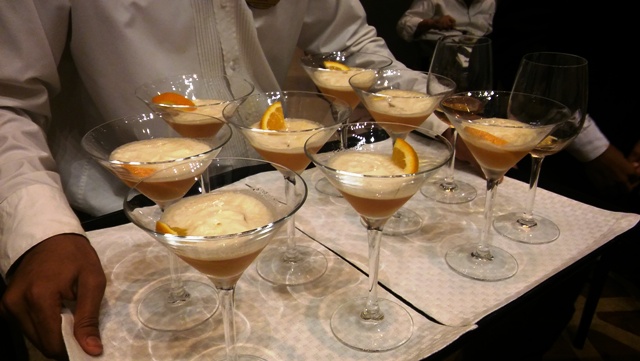
Presentation: Cocktail "Pomegranate Sour" (recipe in image below)


Seven generations of the Beam family have been distilling at the Jim Beam distillery, making it the number one selling bourbon in the world. Jim Beam White is one of the cleanest, yet full flavored bourbons with caramel and vanilla sweetness followed by a peppery spiciness. Jim Beam is now bottled in India making it even more accessible.

Paired with:

Podi Idli with Upma cigarillo (V)
Steamed garlic pod centered dumplings, crisp cigarillo with mushy filling.

Chettinad chops with Upma cigarillo (NV)
Slow cooked succulent lamb chops, crisp cigarillo with mushy filling

"Pomegranate Sour" worked perfecty as a foil for the podi and chettinad spices- cleansing and refreshing the palate.

Fourth Course


Woodford Reserve, ABV 43.2%
Type: Kentucky Straight Bourbon
Presentation: Chilled, infused with a saffron strand and with an aam papad (semi dried mango pulp) garnish.


Woodford Reserve is the only triple copper pot still distilled Kentucky Straight Bourbon whiskey. It is made in small batches to preserve it's artisanal character.

Paired with:

Badam ki Galouti, mango kachumber (V)
Browned almond paste, Sprouted moong pistou, saffron flat bread, salad

Silvatte ke shammi, mango kachumber (NV)
Hand pounded lamb boti kababs, saffron flat bread, and salad

Shatbhi called this combination as "Lucknow meeting Kentucky".  The intensely dried fruit and sweet spice flavours of the Woodford, further infused with a hint of saffron and served with a bite of aam papad, blended effortlessly with the softly spiced galouti and mango kachumber.


Fifth Course


Jack Daniel's Liqueur, ABV 35%
Type: Tennessee Honey
Presentation: Chilled, straight up


Jack Daniel's Tennessee Honey is a whole lot of Jack with a little bit of honey. It has warm honey, caramel and vanilla flavours with a little nuttiness and hints of anise

Paired with:

"The Three Sweet Act"- an amalgamation of three cities on a plate. The Beetroot halwa from the Mughal era, the Alphonso payesh from the contemporary Bengalis and the saffron milk solids samosa from the northern India.

The iced Jack Daniel's Tennessee Honey complemented the trio of favourite Indian dessert flavours, with the rudder of balancing acidity.

"The Team" with Shatbhi Basu (middle) and Chef Vipul Gupta (extreme right). Rishi Raj Singh, Resident Manager Welcomhotel Sheraton (2nd from left) can  also be seen in the photo.

The Showstopper


Even as the guests took charge of their mobiles to summon their respective wheels, Shatbhi urged them to stay put for a smokin' hot experience. 'Smokin' ' it was literally, and 'hot' it was on the chutzpah front. Choco Nut Madness (see recipe in image below)  aptly contained some of the favourite ingredients of the American way of life, wrapping up the evening on a lingering American note! 


P.S. Recipes above have been deliberately put as images to facilitate downloading like any other image from the www. Please feel free to download  and share with fellow whiskey enthusiasts.

Sunday, March 20, 2016

A Holi Holiday With Special Drinks and Food

The arrival of spring in India also ushers in Holi- the festival of colours where people, irrespective of their stature in the society, generously smear  colour  and embrace  each other  in the spirit of universal brotherhood. This colourful revelry is preceded by a night of bonfire which has a significant legend associated with it. If you would like to know more about Holi, here is a good resource giving out the details ‘holi’stically:

http://www.holifestival.org/holi-festival.html 

This Holi, I am proceeding to my hometown for a short vacation to play colour with  my near and dear ones specially those whom I have not met in some time. I think the occasion will be a good excuse to get in touch once again. Owing to my association with the world of beverages, I am also sanguine that expectations aplenty would be greeting me on the drinks front. This realization sparked a bright idea- why not seek quick inputs from inspiring trade professionals (a.k.a. Trail Blazers) who are also good friends?  Presto! the recipes materialised within no time after a round of tasting sessions and the result is produced here in the form of images intended to make downloading and sharing easier. 

Enjoy and here's wishing you a safe and happy Holi

The Drinks: By Ace Mixologist Jeewan Papola


The next time you visit The Lalit, don't forget to visit their bar at 'Kitty Su' one of the most happening night clubs of Delhi. Mixologist Jeewan's magic will make you chew your Martinis and serenade your Margaritas like never before...


Jeewan's Holi  recipes for Guns 2 Gewurztraminer


The Food: By Celebrity Chef Vaibhav Bhargava


Chef Vaibhav's repertoire of Pan Asian dishes is so large that it is a task in itself to shortlist a few for special requirements like these. However, for Holi,I requested him for 4 recipes with the following criteria-  finger food, soup and  bowl meal,  easily preparable with commonly available ingredients and easy to handle. He was kind enough to honour my request, though I honestly feel that his expertise with oriental food (specially Japanese cuisine) can only be experienced by visiting him at the  'Pan Asian' in Sheraton Saket. (Mention to him Guns 2 Gewurztraminer and I think he will give you special treatment too!)


Saturday, March 5, 2016

An Indian Wild Tiger Of The Rum Kind

A furry exterior imitating tiger skin, a nationality orientation and an acknowledged cause to support- are we really talking about a liquor brand here? Indeed. What better if that brand aspires to bid for an unclaimed Indian legacy in the world arena, not on hype alone but with some serious ground work. It translates into the  Indian Tiger arriving  from the Wild in an entirely different avatar- the Rum-avatar (pun unintended). Welcome to the 'beat' of Wild Tiger Special Reserve Rum– India’s first super premium rum.


History has it that wherever sugarcane is grown, distillation of rum has logically followed, going by the simple fact that the beverage is produced from molasses- a byproduct of the sugar industry. What originated in the Carribean islands, proliferated to other parts of the world in the colonial times which included India, the second largest sugar producer of the world.

Late this February, as I met Gautom Menon ,  brand owner of  Wild Tiger Rum (WTR)  who prefers being called as its Chief Brand Ambassador, he narrated his  story of passion that steered him towards evolving a super premium rum from India visualised to rub shoulders with the best in the world. Initiated rather reluctantly into their family business of bottling alcoholic beverages for reputed producers, the first thing that came to Gautom’s mind was - why  were they not producing  a brand of their own? And nothing better than rum occured to him as he realised that there wasn’t  a single premium rum brand from India that echoed on a global stage. Presto! The idea of WTR was born,

So what’s so special about WTR? Hasn’t the iconic Old Monk  kept  India on the world rum map since eons? Gautom elaborates- “ the idea behind WTR is entirely different. It pushes the envelope by evolving a flavor profile that is refined and appealing to the global rum lover. Traditional Indian rum is usually from 100% molasses. Wild Tiger is additionally  blended with some percentage of cane juice spirit, which gives the final blend a lot of aromatic notes and flavour depth (aficionados will recall Cachaça from Brazil which is exclusively made from sugarcane juice and is used in their famous national drink Caipirinha) . This cane spirit is double distilled in pot stills to impart the refined dimension to the resultant blend." Gautom also emphasizes that they mature their rum in American oakwood barrels that are charred to reactivate the wood hence giving it a further layer of    complexity.”

Tasting Wild Tiger Special Reserve Rum with Gautom Menon

WTR however is envisaged as much more than a refined expression of rum. It wears its Indian identity literally on the sleeve with India’s national animal distinctly engraved in its identity. An identity that goes beyond symbolism to contribute 10% profits towards Tiger Conservation in South India in active collaboration with NGOs and prominent Tiger experts.  The social responsibility aspect is also emphasized with their bottles being made from recycled glass and all the paper used in packaging ( labels, neck tags, cartons and brochures)  being made from recycled paper. And yes, each bottle sports a unique stripe pattern to make it exclusive to its buyer.

Time was ripe to sample the rum and Gautom channelised the 'tiger' into my glass After the nosing and initial undiluted sip, I added an equal amount of water to let loose the phenolics. The initial impression itself validated the preceding conversation to an extent, before I went quiet to mull over it in deliberation. Here's sharing the details in the graphic below:(feel free to download and share with your friends):


After a soft launch in London during the UK Rum Fest, WTR  was launched in UAE, followed by Bangalore Duty Free in Feb 2016. It is slated for registrations in the USA and will also be available in UK and Canada before end of March 2016. This will be followed by Thailand, Australia, Denmark and Maldives. “Our goal is to have extensive presence in at least 16 countries by the end of 2016”, said Gautom.  On my query he also informed that in India, the rum will initially be available only in Duty Free owing to limited production. However, a call will be taken subsequently to introduce it in other channels.

Until then the passport to spot the  'Wild Tiger' will be your  Passport itself!

Tuesday, November 17, 2015

Experiencing the Charm of Glenfiddich

Festive season in India is in full bloom with Diwali just gone by and the countdown to X Mas and New year  well on its way. Amidst all festivities, I recently had the privilege of being invited by James Pennefather, General Manager William Grant and Sons in India for a vertical tasting of Glenfiddich whisky around a paired dinner at his residence. On most occasions, I have been attending or conducting wine dinners, so the invitation came as a unique opportunity to refresh my knowledge on whisky. It was only incidental that a few days prior, I had the pleasure of conducting a whisky appreciation session for a group of Executive MBA students from the  Duke University USA, that has famous alumni like former US President Richard Nixon and philanthropist Melinda Gates on its honour rolls.

There is a great deal of similarity between wine and whisky tasting. Cynics may scoff at this comparison but the fact remains that appreciating any aged alcoholic beverage involves a set methodology. It is all about discerning the aromas, palate and finish in the backdrop of the beverage’s provenance. So much about similarity- now the differences. Whisky is a distilled product made from grains while wine is  fermented from grape(s), hence there are different variability factors for both. I have endeavoured to summarise these in the graphic below:


Coming to the Glenfiddich dinner at  James’ place, it was heart warming to be welcomed by him in the company of his cute son Richard who had just returned from a Halloween party with ‘scary’ paint et al on his face. This warmth continued with James  carefully seeking to know my preferred way of enjoying  whisky, which I specified as a 1:1 dilution with a couple of ice cubes. The party got rolling as the guests – a select group of whisky connoisseurs- started acquainting themselves with each other. The graceful Mrs Pam Pennefather too, briefly joined-in to make this ‘stags only' (pun intended) gathering   feel at home.

The muster was followed by James introducing the proceedings that lay ahead before we took our seats for the tasting.

Band of whisky brothers

About Glenfiddich 


Glenfiddich means “Valley of the Deer” in Scottish-Gaelic language. Situated in Dufftown (popularly known as “whisky capital of the world”), in the Speyside region, Glenfiddich  distillery was established in 1886 by their founder William Grant, whose name is still borne by the family owned company. They also own the Balvenie and Kininvie distilleries in the same region.  

In the course of James’ presentation, he  showed an interesting image depicting the 1909 visit of Mr. Charles Gordon, son-in-law of Mr. William Grant to India with some of his staff on a horse carriage. On the lighter side James also showed a similarly themed image of his, albeit in an auto rickshaw!

(Above) Mr Charles Gordon on his first India visit (Below) Mr James Pennefather with his staff in the current day


The Tasting


First Course

The first whisky to sashay on the ‘ramp’ was Glenfiddich 18 Years Old (YO). With its enchanting antique gold colour the whisky had aromas of freshly baked apple pie with an unmistakable cinnamon touch. It was thoughtfully paired with the entrée course of parmesan sable with mascarpone truffle mousse and petit légumes which was innovatively served on a rustic stone platter.


James also emphasized that it is not always necessary to taste whiskies vertically in ascending order of age. It all depends on how one would like to highlight the subtle differences in each kind of whisky. In this tasting, he informed that the stress was on typical flavor profiles that were worked around the respective food courses.

Second Course

Next was Glenfiddich 15 YO. Apart from being aged in new European oak and Sherry casks  this whisky is further mellowed by a dynamic aging method innovated by their malt master, which is inspired from the ‘solera’ method followed in Sherry production. Only here, the ‘solera’ comprises of a single large oak vat (as opposed to a pyramid of interconnected barrels for sherry) that has always been half full since 1998. As the whisky is tapped from the vat, equal amounts are replenished from fresh batches, making it a continuously moving blend.

Paired with the main course of spice roast lamb confit with spiced jus,  the ample body of this fruity and floral whisky stood in apt balance with the varying flavours and textures of the food.


Third Course

The dessert course of decadent hot chocolate fondant with Baileys mousse saw the companionship of Glenfiddich 21 YO that carried rich aromas and flavours of fruit cake, caramel and dark chocolate. The USP of this whisky is its finishing in Carribean rum casks that originate from a special blend of rum made for the Glenfiddich distillery. With its deliciously warm character, this  was my favourite of the evening (and therefore I requested for an additional pour too!).


Surprise (4th) Course !

 As James briefly went inside the kitchen area, we thought it was for some routine instructions to his staff. Instructions he did pass- and they turned out rather special, as they culminated in the serving of Glenfiddich Anniversary Edition to us. The Anniversary Edition was specially created to commemorate 125 years of Glenfiddich and is available only in travel retail in selected outlets. It has a peated-fruity character commonly associated with Islay malts and if one were to taste it blind with other single malts whiskies, it could be a tough nut to crack. However mulling over it longer, I realized that apart from the peaty red herring, the underlying essence of Glenfiddich style is scrupulously maintained by the malt master. I hope that I get to taste it more often to face the blind tasting challenge sometime. The course was served with assorted cheese platter for us to experiment with the pairings. Truly the pièce de resistance of the evening!


My side of  the table

Thus concluded our voyage on the "Glenfiddich seas" with reminiscences of flavours still on our palate. Freshly brewed coffee (which we all needed to get sober again) capped the malty evening as we bid adieu to James, drenched in the spirit of the Stag,

The spirit that is shared enough to make it the top selling single malt of the world!

Au Revoir!


Thursday, August 13, 2015

Tasting Janus- the first 100% Grape Brandy from India

Last week ended on a heady note for me. As I received a call from Prarrthona Pal Chowdhury, Head Marketing, Brandy Project & International Brands  at Sula Vineyards proposing a private tasting of Janus- their recently launched premium brandy- I  agreed on it despite the short notice. Having already read about the Mumbai tastings of the brandy, I was eager to taste  it at the earliest, and here was a ready opportunity.

But why was I so keen to taste an Indian brandy after having experienced many international brands of repute? Simply because Janus happens to be the first 100% grape brandy produced in India. Then what exactly are the rest? For that let us first try to understand brandy in the right perspective.

What is a brandy?


The word  “brandy” originated from "brandewijn" - a Dutch term for burnt wine. In olden days when wine was being transported in barrels through the tardy sea route, there were frequent cases of spoilage owing to climatic variations and uncontrolled storage conditions. A workaround to this problem saw wine being distilled, dramatically improving the shelf life of this “burnt wine”, which was then consumed at the destination diluted with water.

But there is more to brandy than just “burning” wine. Evidence of its use in medicine over the centuries is aplenty. It has since then evolved as a refined alcoholic beverage, largely revolving around two aspects- Geographic Indication and Oak Ageing. Hence we know Cognac, Armagnac and other fine brandies the way they are.

The Brandy classification however applies to any fruit originated spirit and not just grapes. Hence we have Calvados (an apple brandy), Poire Williams (a pear brandy) and so on. But grape brandy has been most prevalent with its recognized high antioxidant and  remedial properties. Probably the reason why the French coined the special term Eau de vie meaning "water of life" for this elixir.

Given this background, it becomes imperative that when we buy a brandy for its virtues, it should  be a 100% grape spirit rather than a blend of other distillates. In the Indian context (also in majority of Asian region) the latter is quite common with even grain based spirits finding their way inside the blend . Hence the arrival of a home grown 100% grape brandy  as Janus has come as a welcome development for connoisseurs of fine beverages in India.

The Blind Tasting


My tasting experience at Prarrthona’s behest involved  three samples poured out of non descript bottles with a simple premise- to discern the smoothest one and to guess which one could probably be Janus. The “simple” agenda though, had more to it as she further told me that samples other than Janus could be anything- whisky, rum, or another brandy.  The task looked uphill but I decided to be patient and go over the samples in three iterations as follows:


  • Ruling out by exception.
  • Identifying typical traits of each sample.
  • Confirming my findings through a rerun.
The tasting sitting with Prarrthona Pal Chowdhury at ITC Maurya (Pics: Prarrthona Pal Chowdhury)
Here is how it went (my inferences shown in parentheses):

Iteration # 1 : Colour and Aromas only.

Sample 1: Light coloured with unmistakable malt notes amongst others. (most probably a whisky).
Sample 2: Glowing amber colour, a honeyed nose accompanied by  citrus fruit aromas (undecided).
Sample 3: Deep gold with peaty nose (a scotch whisky for sure).

Iteration # 2 Aromas and Palate.

Sample 1: Malt notes confirmed with floral and sherry notes. (reasonably sure about whisky).
Sample 2: Sweet spice and floral notes with the smoothest finish of all (betting heavy on brandy)
Sample 3: Deep gold with peaty nose. Rich flavours but not so smooth (a whisky for sure)

Iteration # 3 Confirmation.

Sample 1: Earlier observations confirmed. (This is a whisky).
Sample 2: Most likely this is Janus.
Sample 3: Definitely a whisky.

As I conveyed my opinion to Prarrthona, she was delighted the same way as I was. For her, it was the vindication of confidence in her brand which she had so boldly pitted against other reputed ones. For me, it was a reassurance of my primal senses related to beverages appreciation.

Having known which one was Janus, I could now dwell  leisurely to analyse it as a brandy. I found that apart from the smoothness it had a refined feel that was inclined towards the Cognac style replete with a full body and a fruity and spicy character.


Prarrthona told me that the Cognac orientation of Janus was a given since the product had started as a collaboration between Remy Cointreau and Sula. With the exit of Remy Cointreau from India as a business rehash and  selling of their assets (including brandy stocks and equipment) to the Indian winemaker, Janus continues to be produced using the same equipment (pot stills, limousine oak barrels etc)  that was specially  imported from Remy’s facility in France. French Master Blender, Yonael Bernard  has purposefully created a smooth and distinctive blend that carries the Cognac character with aplomb.

Currently Janus is available in Goa at ₹ 1500.00 / ₹ 395.00  for a 750 ml  / 180 ml bottle. I am told that it will soon to be launched in Mumbai, Delhi and Bangalore followed by other cities pan India. 

But isn’t it a marketing challenge to convince the average Indian consumer to buy a significantly higher priced brandy when there are lesser “brandies” that sell at nearly half the price? Prarrthona tells me that they see Janus as having no competition in the current brandy market owing to its entirely different niche. However, she acknowledges that they will have to conduct awareness campaigns to educate the consumer on this aspect.

In the meantime, I seem to have found a perfect local companion for my “Sidecar”.


Sunday, June 7, 2015

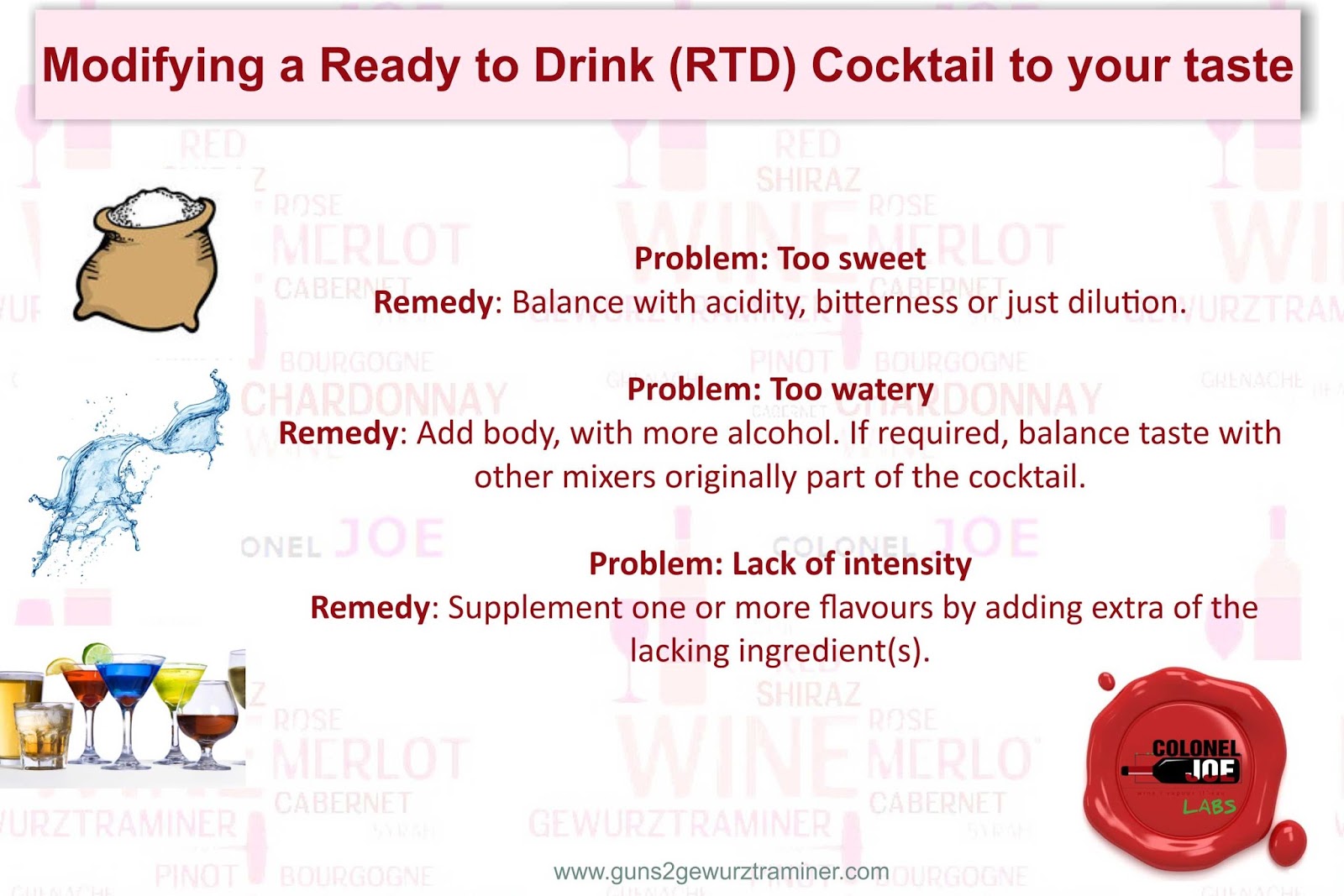
How to customize Ready To Drink (RTD) Cocktails

The scorching Indian summer is at its worst and it’s time for thirst quenchers. Purists would argue that the best possible way to do so is like God intended it - with simple aqua. No disputing that, except if life were so simple then we’d still probably be eating raw vegetables! A change beyond the humdrum is what we often seek and in the beverages context, cocktails embody the spirit of innovation.

However,  preparing a cocktail from the scratch is not everybody's chalice of wine and this is where RTDs or Ready to Drink cocktails score.


Recently I gave a closer look to some of the RTDs  available in the Indian market. Not being a particular fan of RTDs-  believing that there is no substitute to freshly made drinks- I also acknowledge  RTDs for the convenience they carry, especially when you are pressed for time or do not have the inclination to assemble the requisite paraphernalia.

A nagging problem with RTDs though, is that they are formulated on the  “one size fits all” approach. This brought me to ponder about customizing them to individual requirements. Some trials in my newly created "Colonel Joe Labs"  and the results have me excited enough to share these here.

But before that, let's have a quick look at some simple steps to customise a cocktail :


Adhering to the above guidelines, I tweaked the following RTDs (Prices indicated are ex Delhi).

Cocktail Genre # 1: Sangria


General facts: The drink owes its name to the word 'Sangre' which is Spanish for 'blood'. It is a red wine based cocktail added with a little bit of alcohol and other mixers, thereafter steeped with fruit chunks and chilled for several hours.


Cocktail Genre # 2: Carbonated (Bacardi Breezers)


General facts: Carbonated cocktails are fun and facile particularly with the younger crowd. They are a good alcoholic option to Coke, Fanta and the ilk. Mostly with lower alcoholic content (close to regular beers) , they are a good proposition for people new to alcoholic beverages. Plus there is always the option to fortify the drink with more alcohol if required.


Cocktail Genre #3: International Classics


General Facts: International classics like Cosmopolitan, Mojito, Margarita etc. have been around as RTDs since decades and are preferred the world over for their connaissance amongst cocktail lovers. However, the taste differs from brand to brand and a person who has experienced the real mojo will instantly separate the chalk from cheese.

The following cocktails are from the brand William Pitterson which is owned by the iconic French liqueur producer Marie Brizard. When I first presented William Pitterson (WP) cocktails at a Cocktail and Food pairing to an agog audience, I was surprised at the level of freshness they carried. 
All the WP variants were so delightful that had they been served blind, I could have mistaken them coming from ingredients fresh from garden. 

However that does not imply that you cannot improvise on them to suit your taste, or more importantly, serve them optimally.


Wednesday, December 24, 2014

7 winter cocktails in the run up to the New Year!

Happy New Year! I say this much in advance, having wondered even earlier as to how I could possibly add value to your New Year celebrations through a year-end special blog post. Bingo- came the idea when I went visiting hotel Radisson Blu PlazaNew Delhi and met their Beverage Manager Eldo Jacob- a  young  professional  full of  verve and pizazz.  Eldo  has this parfait amour (pun intended) for libations that I registered, sensing his unrelenting streak for innovation.  It thus occured to me that if I could get behind the bar with him, many hidden pearls were likely to be uncovered- all to the benefit of beverages passionates like you.

Sure enough, Eldo and me had a rendezvous fixed-up and the upshot  expectedly turned out as a  warm bouquet of drinks just apt for these winter months.  At the rate of a drink each day starting X-Mas, these seven drinks are sure to culminate the year gone-by  in style and leave you literally in high spirits to welcome the nouvelle année. Enjoy!

Eldo Jacob, the innovative Beverage Manager at Radisson Blu Plaza, New Delhi


P.S. In a marked departure from my earlier blog posts, this one is almost entirely in images with the sole aim to facilitate downloading of recipes with a right click.  Sharing them on  social media platforms like Facebook, Instagram, WhatsApp, Twitter, Telegram......... too, will be a cinch, So feel free to share the good times with your near and dear ones.


Cocktail # 7:  The perfect  X-Mas Drink


Cocktail # 6: Boxing day bonhomie


Cocktail # 5 Spicing it up for the New Year eve ahead


Cocktail # 4: Cocking a snook at the freezing temperature


Cocktail # 3 : Mulling over the New Year celebration options


Cocktail # 2 : Gourmet indulgence on  penultimate day of the year 


Cocktail # 1: A toast to the new born year!