Showing posts with label JW Marriott. Show all posts

Friday, August 26, 2016

La Réserve- India's Favourite Wine Relaunched in a New Avatar

"Old wine in new bottle"- is the common refrain to denote cosmetic changes to an existing product. But there’s a subtle variability in its interpretation. If the concerned product is nothing to write home about, cosmetic changes appear unnecessary and maybe a desperate means to ameliorate product consumption. But what if the product is already in the hall of fame? It leads to another proverbial description- “cherry on the icing”.

The latter interpretation was on full display as one of India’s leading wine producers Grover Zampa Vineyards (GZV) relaunched their flagship wine La Réserve innovatively, pairing it with a customized barbeque menu by hotel JW Marriott,New Delhi. Titled “La Réserve Barbeques” the Delhi launch was last in series of similar events in Mumbai and Bangalore.

An infographic from Grover Zampa Vineyards to depict the change

About La Réserve


Those familiar with Indian wines would probably agree that La Réserve Red from GZV has attained cult status on the Indian wine front ever since it  was launched in 1998 . After having developed a distinctive French  inclined ‘house style’, courtesy their  active collaboration with famed wine consultant Michel Rolland and French winemaker Mathias Pellisard, GZV have been successfully able to place this wine as their “prestige cuvée”. The wine is the result of hand-picked selection of GZVs oldest Cabernet Sauvignon and Shiraz vines vinified and matured in French oak barrels. 
Completing the ensemble offering, La Réserve White is a barrel fermented Viognier which according to GZV, is elaborated vintage after vintage with the same zeal as La Réserve Red.

Apart from the refined disposition of La Réserve wines , my personal opinion  finds their utmost USP as being in their consistent quality- which is a difficult ballgame in a non standardized wine industry like India. This prompted me to ask their CEO Sumedh Singh Mandla “ How are you able to ensure a consistent taste more so when you are producing these wines in two distinct geographical locations (Nandi hills in Karnataka and Nashik Valley in Maharashtra) with different terroir elements ?  Sumedh’s reply was quite plausible, as he highlighted that the cuvée blends are carefully managed to incorporate a minimum percentage of common inputs from their oldest vineyards. Though they do not maintain a stock of Réserve wines for blending, it is the quality of produce that is ensured through sound viticultural practices and oenological expertise at hand.

The New Avatar


The new packaging of La Réserve is not restricted to the label alone. A chunkier broad shouldered bottle similar to the Super Tuscans, is weightier and power inducing. While the older ‘white-gold-black’  label was minimalistic and appeared Victorian, the newer one is big, bold and flamboyantly sophisticated keeping pace with the current times. The embossed graphics in dark grey, wine red and gold/silver (for red/white wines respectively) are a pleasing combination complemented with  a pleasant tactile feel.  Another layer of differentiation is rendered by the capsules- gold for red, and silver for white - which makes the variants' identification easy even from a distance. The price of both these wines ex Delhi retail is  ₹ 1050.00.


The Launch event


Anticipative guests comprising of trade professionals and media witnessed unveiling of the new labels by  Sumedh Singh Mandla, CEO GZV and Antony Page, GM JWM, New Delhi even as they savoured the same wines. Though the organizers had envisaged an outdoor setting, the Indian monsoon dictated otherwise, resulting in the last minute shift to the crystal ballroom at JWM. The contingent venue (and the JWM team) did well to spaciously accommodate the gathering as well as the bar/ live barbeque stations.

Sumedh Singh Mandla (L) and Antony Page (R) unveiling the new bottles

As mentioned above, JWM Delhi has evolved a special barbeque menu for the La Réserve wines. It is common knowledge that a robust red wine invariably goes well with rustic barbeque preparations, however with a white wine included, more planning is necessitated than meets the eye.  JWM handled this aspect well by incorporating white wine centric  canapés and cheeses as pass arounds, well recognizing that most guests would  prefer to sample the white wine first. However for those not meeting this assumption, the main spread too had ample options to support their preference. The respective food stations were made interesting with witty chalkboard graffiti which fired the imagination further.


Hit Pairings at the Launch


With La Réserve Red

New Zealand lamb chop.
Pork Finochiona sausage
Moroccan lamb merguez with red wine jus
Fettucini pasta with thyme infused mushroom ragout

With La Réserve White

Norwegian smoked salmon, Sevruga Caviar, Dill sour cream blinis
Prawns with spicy garlic lemon marinade
Fromage de chevre with crisps
Salad- poached chicken, French beans and prunes with honey mustard vinaigrette


Monday, August 8, 2016

The Riddle of Riedel

It was one of those rare  occasions when the 'lead artist' took a backseat in favour of the 'supporting cast'. As Alexander Zorin, Vice President Sales from Riedel, one of the most respected wine glass companies, unpacked the last of  tasting sets for the ensuing session on varietal specific glassware, anticipation ran high. We were all eager to experience the difference in perceiving wine from optimized Vs. generic glassware. For a change, it was the glass to do the talking rather than wine. The session was conducted at Akira Back- the much talked about Japanese-Korean restaurant at hotel JW Marriott Aerocity New Delhi.   I was in attendance at the invitation of my good friend Ankur Chawla, Director of Beverages at the hotel who also plays a larger role in Marriott's Beverages Committee for Asia-Pacific.


Alexander Zorin demonstrating the uniqueness of each 'varietal specific' glass 

A Wine Tool


The Riedel philosophy unabashedly announces a wine glass as a ‘tool’ that facilitates appreciating the bouquet, texture, taste and finish of a particular wine. To come to this conclusion, they cite their decades of research to arrive at optimum shapes and sizes of the respective glasses. Though Riedel have a history of producing glass dating back to 1756, it was only in the 1950’s that they started producing wine-friendly stemware.  It all began when at a casual gathering, guests were called upon to fetch their glasses from a nearby cabinet and Claus Riedel, their 9th generation helmsman discovered that the same wine tasted differently in the melee of  resulting assortment. He narrowed down on the best glass for the particular wine and  the foundation for grape varietal glassware was laid.

The Premise


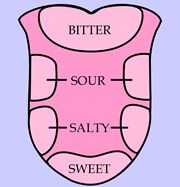
Most of us probably know that human tongue has distinct sensory regions related to different taste
Pic: www.rudyard.org
profiles. Over time, the demarcation of these regions has evolved as a ‘tongue map’ (see image alongside). The theory has been challenged though, in the form of subsequent research confirming that all taste qualities are found in all areas of the tongue. But in the wine context, the tongue map theory has been largely corroborated and glassmakers like Riedel have emphatically proved its relevance.

The taste of wine is largely defined by it’s ‘initial attack’ (how it is perceived immediately on sipping) and the ‘finish’ (the lingering taste after you have gulped it down). ‘Varietal specific’ glassware looks at fine tuning the drinking experience by channeling the wine onto desirable places- taking the tongue map as a guide. Level of acidity, fullness of body, vigorousness of tannins are some of the wine traits sought to be accentuated/subdued using the ‘right’ kind of glass. On the aroma front too, the shape of glass determines how focused or dissipative the bouquet of a wine can get.

Alexander informed us that in the initial years, some reputed Bordeaux producers complained to Claus Riedel of their wines not tasting appreciably well in his red wine glass.  The observation compelled him to do further research, only to realise that the glasses in question were designed with Piemontese wines in mind. This egged him further to come up with specific glasses for Bordeaux wines, followed by several others. Today Riedel glasses have a range of approximately 450   different shapes that cater to the whims and fancies of their finicky ‘occupants’.

The Technicalities

Image courtesy: Riedel

So how does the fluid mechanics of wine get affected   in such specialized glassware? The Riedel philosophy looks at three parameters:


  • Shape of the bowl
  • Size of the bowl
  • Rim diameter of the bowl


Apart from the above, the stem and base of the glass form an important part of its architecture, to promote stability.

These  parameters determine how much wine is contained in the bowl, how it moves within, and how it gets directed in your mouth. Sounds too technical? Imagine yourself puckering your lips to sip from a narrow mouthed glass vis-a-vis a broad mouthed one. The wine in the former case will tend to flow towards centre of the palate rather than filling it up instantly as in the latter.

The Validation


The proof of a pudding is in its eating, hence we took our places at the neatly arranged table that had five glasses each, precisely arranged on printed mats on their respective places. 4 glasses from Riedel’s Veritas (their grape varietal specific range) completed the ensemble with a water tumbler as the ‘joker’.

The tasting setup

Alexander started the experience by urging the participants to pour some water in all the glasses, to sip from each and feel how differently it flowed inside the mouth. The initial point was made and well received.

The wines followed, with each of them sampled from the respective varietal specific as well as the other glasses. The comparisons stood out starkly with each wine blossoming optimally only from its respective glass while appearing comparatively lackluster from others. 

For example, the aromatic Sauvignon Blanc (SB) was subdued in expression in the Oaked Chardonnay glass and the Chardonnay returned the favour by appearing too limp from the SB glass. Similarly the Cabernet blend demonstrated good balance from the Cabernet Sauvignon glass while it appeared too tannic from the SB glass.

The constant juggling of glasses during this exercise did feel like a musical chairs of sorts but achieved what we were there for- experiencing first hand the relevance of varietal specific glassware.

The Bottomline


Does all this mean that we junk our ‘average Joe’ red and white wine glasses and start buying new glassware? Not exactly. Even Riedel have a generic glass recommendation from their range (Vinum XL Shiraz for red wine and Ouverture Magnum/Riesling Grand Cru/Chianti Classico for white wine ). However for obvious reasons, they would  recommend people buying the varietal specific stuff. In my opinion, buying such specialized glassware would be good idea if you satisfy all of the following conditions:
  • You regularly drink high pedigree wines at home.
  • You have the moolah to spare (specialisation always comes at a cost).
  • Storage space is not a constraint.
  • You have the inclination of going that extra mile to maximize your wine experience.
The last point is most important as I realized when a multi millionaire wine connoisseur friend once told me- “I would rather spend more on wine than fussing over glasses”. But then, there was also this regular wine lover friend who couldn’t stop raving about his newly acquired Riedel's Vinum tasting set .

As for me, the Veritas tasting set gifted by Alexander will keep me occupied for days to come.


Tuesday, April 7, 2015

Jacob's Creek Longest Reserve Table: Fine dining à la style grande

Jacob's Creek is India's best known Australian wine. The brand that came into being in 1976, is owned by the multi-national wine and spirits giant Pernod-Ricard and is named after a place in South Australia where a gentleman called Johann Gramp planted his first vines on the banks of the Jacob’s Creek in 1847. 

Recently, Jacob's Creek launched a unique event, “The Longest Reserve Table”, for the first time in India on the 1st of March at hotel JW Marriott, New Delhi where I was invited to take a seat. Notching up a century of wine and food enthusiasts at one single table, the concept brings together people who love gourmet cuisine and good wines.


Being a Sunday, a relaxed mood amongst the attendees facilitated the right atmosphere for the rendezvous. However, the plans did go into a spin- albeit temporarily- due to an unforeseen wet spell in Delhi that necessitated the event to be shifted indoors. But thanks to the super efficient team at JW Marriott led by Ankur Chawla, the Beverages Manager, the transition was seamless (even if I was envious of fellow wine lovers in Bangalore, who were blessed with a lovely sunny day at the outdoors session).

The engagement started with a refreshing sparkling as Jacob’s Creek Pinot-Chardonnay  as the guests assembled. Made from two of the Champagne varietals, the wine is an easy going sparkling ideal as an aperitif and an excellent conversation starter.

As we sat down, a five course continental menu  crafted for this special table by Chef Pavan Kumar Chennam, Executive Sous Chef of the JW Marriott New Delhi Aerocity, was presented. The level of deliberation and understanding of the nuances was evident in the pairings. 

My gauche et droite were occupied by my chosen wine friends, and we ordered different options from the menu so that we could get a panoramic view of the dining experience. We might have earned the ire of some fellow diners, as we did get quite excited at times as we exchanged notes.

Thus it went:


Course 1: Sous vide chicken with roasted pears and crispy frisée (NV) or Goat cheese and beetroot coulis with apricot chutney (V).

Wine pairing: Jacob’s Creek Chardonnay.


The sous vide chicken was tender and mild flavoured with the roasted pears and the frisée (a leafy
vegetable) adding dimension to the flavour and texture. It worked well with the classic Australian oaked Chardonnay having stone fruits and creamy disposition. My vegetarian neighbour felt similarly, even if his tangy chutney spiced it up a bit more for him.

Course 2: Spiced root soup with sour cream and onion crisps.

Wine Pairing: Continue with Jacob’s Creek Chardonnay.

This was a delectable soup - creamy, nutty and toasty. It was quite engaging with the continuing wine, shoulder to shoulder with the refreshing acidity, and the toastiness of oak. Defying conventional wisdom, soup is not a waste of time with wine.


Course 3: Salad of white asparagus, green asparagus, toasted mustard, extra virgin olive oil and greens.

Wine Pairing: Jacob’s Creek Reserve Chardonnay.


Justifying its Reserve status, the wine had more complexity while retaining the common attributes of the previous one. It was a fuller wine with a honeyed feel and a softer demeanour. All this worked well with the varying textures of the salad components.

Course 4: Red Snapper with brown butter, celeriac purée and caper crumbs (NV) or Corn Fed Chicken with parsley, cous cous, country style potatoes, eryngii and enoki (NV) or Ravioli with zucchini caponata, four cheese and cured artichoke (V).

Wine Pairing: Jacob’s Creek Shiraz Cabernet and Jacob’s Creek Reserve Shiraz.


Curious to try two robust red varietals with fish – which is a tough pairing according to conventional wisdom – I ordered the red snapper. Had it not been for the accompaniments, the pairing would have fallen flat. But, in the overall scheme it did sail through. Both my wine buddies who had ordered the corn fed chicken and the vegetarian option seemed quite happy.
The Shiraz Cabernet was very expressive on the nose with red fruits and spice accompanied by a rounded luscious palate. It is a supple wine, effortlessly elegant on the palate. The Reserve Shiraz was the big brother with ripe black fruit flavours, pronounced oak overtones and a firmer structure.


Course 5: Cherry, Lemon and Mascarpone Tart with mulled Jacob’s Creek ice cream.

Wine Pairing: Jacob’s Creek Rose Sparkling.


The salmon-pink wine had aromas of fresh red cherries, strawberries and sliced baguette. On the palate, it was refreshing as well as creamy with mixed berry flavours. A dry wine with dessert always remains a challenge, but the fruity nature can pull it off. In my opinion, the chef approached the pairing with a great deal of insight by incorporating a wide flavour profile (sweet, sour and umami) so that it worked for the majority in some way or the other.

My biggest anticipated challenge was the service. I wondered if so many people could be taken care of at one go – one single table added one extra level of unforgiving complexity. But, the service was immaculate and extremely precise throughout.


Commenting on the launch of the series, Jacob’s Creek Reserve Table, Kartik Mohindra, Business Head – International Brands at Pernod Ricard India said, “The Jacob’s Creek Longest Reserve Table offers consumers a unique dining experience, showcasing our range of very expressive varietal wines and their versatility with various cuisines.”


It’s community dining of gastronomy enthusiasts – with the fine dining flair. If you are wondering how this might be, then the closest you can possibly get is by booking a place online at the next "Longest Reserve Table" in your city in April or book your very own ‘Reserve Table’ by making an online reservation at www.reservetableindia.com. Priced at  ₹2500 to Rs. ₹3000 per person  it promises to be good value for your money.

Buoyed by the success of the program, Kartik shared with me that following this launch, the hotels will be offering 3 course meals paired with Jacob’s Creek wines in four leading restaurants of each city. The focus will be to pair the wines with the culinary expertise of the respective chefs.

It's fine dining - la style grande!


(Published in vino india)

Monday, December 1, 2014

What they teach you in a Champagne Masterclass

Having six Champagne glasses in   front of you with  corresponding bottles to be poured in distant vision is a proposition most of us would call fit for a dream. Add a tasting sheet in the foreground and the context changes from pure indulgence to a surrounding rim of onerous responsibility - a responsibility to objectively and platonically dwell into the virtues of Champagne- a fine beverage, subordinate only to the life sustaining aqua.

My side of the table 

The tasting line up

As Thibaut Le Mailloux, Director of Communication at Comité Interprofessionnel du Vin de Champagne (CIVC)  gave finishing touches to his Champagne Masterclass presentation and  the perfectionist Rajiv Singhal, Ambassador of Champagne in India  deftly stroked the final touches at JW Marriott, Aerocity, New Delhi this November, I greeted them with “Bonjour- Vous allez bien?” and saw Thibaut’s face light up with instant recognition. I had met Thibaut  in Epernay, in 2012 during my scholarship trip to CIVC in Rajiv’s company and it looked that the bond had just rekindled.

(L-R) Thibaut, self, Rajiv and Ankur Chawla (Beverages Manager JW Marriott)

The Champagne Masterclass, which is held regularly across the globe by CIVC aims at reinforcing the simple fact- that Champagne comes only from Champagne, with the historical perspective thrown in to emphasize the beverage’s centuries old tradition through the crests and troughs of  time. But besides the veritable history, it  dives deep  into various styles of Champagnes, peculiarities of different regions within the arrondissement  (department) and different styles of Champagne – to name a few.

The Masterclass in progress

 Beverages managers from different star properties (for whom the masterclass was meant) had their skills polished by Thibaut in this rendezvous, and their exuberance was quite palpable by the type of questions coming in- from dosage issues to simple but relevant ones like which Champagne out of the six for the day was Thibaut’s favourite? The seasoned professional but naturally, handled all the volleys with élan.

Coming to the Champagnes, these depicted the amount of brain racking that must have gone into their selection to emphasize each style. The table below amplifies the sequence:


The beauty  of the session was that it did not solely depend on sampling wines but to create the right perspective before the first verre was lifted. For hospitality industry it becomes absolutely essential to understand the evolution of iconic beverages like Champagne, to be able to present them better to their valuable clients for driving home the value derived. To that effect I think that the session achieved that and much more within a third of a day’s proceedings.


Some random  ‘ Pearls of Wisdom’ gathered from the session were :

  • The Champagne viticultural practices are  highly environment focused with advanced R&D being incorporated at all stages of production. One  such measure is ‘Sexual Confusion’ wherein plastic capsules containing phermones are located strategically within vineyards. These phermones emit same sex perfume for pests, deterring them from reproducing and hence pesticides are not required for their control.
  • The Champagne Appellation has faced brand infringement issues not only for sparkling wine producers but also global luxury brands making perfumes, shampoos, cigarettes  et al. It has successfully contested many such cases in the courts. 14 Champagne Bureaus located in top 10 export markets as well as BRIC countries  act as Champagne’s vanguards. In India the bureau  is headed by Rajiv Singhal.
  •  No Champagne bottle across the world  is available without a proper label indicating its provenance. If one is lured by a purported Champagne without label  at a bargain price- it would most certainly be a fake.
  • 83% of Champagne sales are consumed within 10000 km radius of the region. This is due to ease of geographical access as well as taxation issues.
  • Out of the 11 mn of wine and spirits exports of France, two thirds is wine and out of this, two thirds is Champagne.
  •  Many Champagne houses have interesting stories  to their names. For example, Drappier Champagne comes from a family enterprise, which started its business with bed linen several centuries back and switched over to Champagne production when it started becoming popular in early nineteenth century. In French language Draps means Bed sheets and hence the name. 
The session concluded with a photo for posterity


Wednesday, April 9, 2014

The changing demeanour of a Wine: à l'instant Taittinger


How important is ambience for  wine enjoyment? Does a change of place affect the wine experience you have? While it is no secret that a setting for wine appreciation should be devoid of any strong odours, coloured lights et al, the contextual environment related to wine appreciation is an often  overlooked angle.
I recently had the opportunity  to do a Quod Erat Demonstrandum on this theory when M. Nicolas Delion Export Manager Asia Pacific for Taittinger  visited New Delhi in March 2014 to present their Champagnes in the backdrop of Taittinger’s association with FIFA world cup 2014. The venue was the opulent Oval Bar at hotel JW Marriott, Aerocity, New Delhi and three  Champagnes from Taittinger were presented for tasting- two being the same  I had swooned over not long back (one of these described in my previous blogpost on Taittinger).


The Oval Bar at JW Marriott,  New Delhi
Coming to the two different scenarios- the first one was the enchanting environ of Château de la Marquetterie, the 18th century manor surrounded by one of a kind vineyards  owned by Taittinger and the second - the classy Oval Bar  Both these places were poised for wine appreciation as under:


Château de la Marquetterie
(CDLM), Champagne, France
Oval Bar, JW Marriott New Delhi
Format
Five courses paired dinner preceded by an aperitif session at the vineyards.
Informal tasting with accompanying hors d’œuvres
Ambience
Majestic, ethereal and overwhelming with vineyards all around. Expansive interiors silently telling the history of the centuries gone-by.
Chic, modern and fraîche, conforming to the best in hospitality standards. Dégustation area extending outdoors to breezy cabanas.
Attendance
An exclusive  group of wine professionals and journalists from India.
A diverse group of wine and spirits professionals and journalists/bloggers.
Weather
Dreamworthy
Just perfect.
Common Aspect
A congenial host from Maison Taittinger.


At Taittinger's La Marquetterie vineyards in Champagne, France

At the Cabana zone at JW Marriott,  New Delhi


The wines presented were :

Taittinger Brut Resérve (The FIFA World Cup 2014 official Champagne): A blend of all three Champagne grapes viz. Chardonnay(40%), Pinot Noir(35%) and Pinot Meunier(25%), Taittinger ages this wine for more than twice the duration prescribed by the Champagne appellation (15 months) hence resulting in its superbly mature character.

Taittinger  Rosé Prestige: Ruled by Chardonnay, this wine is blended towards the end with still Pinot Noir wine from the best areas of Montagne de Reims- the ‘capital’ of Pinot Noir grapes in the Champagne appellation. A refreshing wine with a pronounced red fruit character.

Taittinger Noturne Sec: A blend of Chardonnay (40%) and the Pinot grapes (60%), this would be the wine that you would probably date if your party begins at 10 in the night. No wonder Taittinger purports this as the one that ‘awakens at night’ . Histrionics apart, the wine has 17.5 grams per litre of added cane sugar during the making process, that qualifies it as ‘Sec’ meaning Dry.

The different tasting perceptions

Out of the above, I had already experienced the Brut Resérve and Nocturne at CDLM earlier. So did the wines taste any different? They had to- since winemaking is a hand perfected craft where churning out two items with 100% similarity is well nigh impossible even if the intention is so. Factors like variability of vintage apart from those highlighted in the table above come into play and therein lies the charm of expecting something new from a particular wine everytime you meet it . I am cautioned though, to clarify that this does not imply unpredictability in any way, since the differences are just subtle. 

Coming to the wines again:

Brut Resérve

At CDLM
We had this wine as an aperitif  while standing amidst the Pinot Noir and Chardonnay parcels surrounding CDLM. There could be no feeling comparable to tasting a wine while experiencing the very terroir it came from and could well qualify as ‘once in a lifetime’ kind of experience. The wine itself came across as a deeply inhalable whiff of fruity and floral  aromas and a sense of unadulterated pleasure on the tongue. Nothing short of heavenly!

At Oval Bar
Surrounded with multiple luxury potions like Louis Treize cognac, Bordeaux Grands Crus wines and the Super Tuscans, we already felt as having just walked the red carpet. When the wine was served while Nicolas highlighted its FIFA affiliation, an emphatic ‘goal’ was scored with its bold and complex characteristics. But unlike the contemplative mood at CDLM, we swigged it indulgently with the vast range of exotic hors d’ouvres to accompany. Immensely satiating for the senses!

Nocturne Sec

At CDLM
Served with the dessert course of Pistache Macarons, Strawberry Sorbet and a collection of fresh Red Fruits, we enjoyed a well rounded pairing defying the common fixation of pairing  dessert with  sweet wine. Again, the mood was contemplative with us trying to dissect the layers of  both food and wine to understand the similarities/ contrasts. The grand interiors of the Château along with the historical perspective of Taittinger brought out by Mme Dominique Garreta, Directrice Communication at the house made us look at the wine from yet another dimension.

At Oval Bar
The first thing I noticed was the habillage (dressing) of the bottle. As compared to a bright purple label  and a golden foil in 2012, the bottle is now in a chequered polymer covering with different hues of purple. It makes the bottle look funkier and aligned to its ‘awakening in the night’ character. Nocturne being the last wine for the evening, the stage of letting the hair down had arrived. We moved to the romantically lit up cabana area that  rendered shimmering reflections in the water in the backdrop of the night. Sampling it with Prosciutto Crostini, Lamb Pepper Fry and Smoked Salmon Blinis was a different ball game as it brought out the robust aspects of the wine.

Conclusion

What is the bottomline then? To put it in fewest words,most of the factors as enumerated in the table above are relevant to the contextual angle in wine appreciation. These and some others are:
  • Format of the fixture.
  • Overall Ambiance.
  • Tasting group composition.
  • Theme of the event.
  • Type of food pairing.
And finally,  perception is a game of mind- which highlights the importance of a skilled presenter in the whole gamut. Madame Garreta and Monsieur Delion happened to excel in that.

With M. Nicolas Delion Export Manager Asia Pacific Taittinger Champagne
Q.E.D.

Taittinger wines are imported in India by Prestige Wines and Spirits Pvt Ltd. 

Retail prices ex Delhi: 

Brut Resérve ₹ 5800.00
Prestige  Rosé ₹ 7900.00
Nocturne ₹ 7500.00


Friday, February 7, 2014

A Sake Extravaganza!

The massive Sake wall
as viewed from the upper floor
Revisiting something you love is always a burning desire, and so I felt when  invited for an exclusive Sake tasting at the chic Akira Back Japanese restaurant at hotel JW Marriott near Indira Gandhi International Airport, New Delhi. The hotel has come up recently on the Indian capital’s hospitality landscape (after overcoming the security hurdles due to proximity to the airport) and has  already started making its presence felt.Akira Back is its contemporary Japanese Restaurant with Korean essence, named after one of Las Vegas' most beloved and respected chefs- Akira Back. 

The Sake tasting was the initiative of Ankur Chawla, the young and accomplished Beverages Manager of the hotel who has several feathers in his cap- from couture cuisine and fine wines to authoring a best seller book! The tasting was conducted by Keith Norum- the Overseas Operations Manager of Miyasaka Brewing Company,  who specially flew in from Japan for the purpose. Their  famous Masumi brand Sakes are imported in India by Brindco Sales Ltd- the top wine importer of the country.

As we entered the restaurant, an imposing Sake wall panning across two floors, shod with numerous bottles and Sake related stuff greeted us  even as we descended to the sous sol private dining  area. Being an early bird (a habit that often surprises my hosts), I took photos at leisure including one with Ankur and Keith before we got into the turbo tasting mode.

R-L: Ankur Keith and me with the 1.8 litre Sake bottles
About Sake
I have described Sake in details in one of my previous blog posts- For the Sake of Sake. However, for the uninitiated, it would suffice to describe Sake as a fermented drink from Japan, made elaborately  from a special quality of rice and having some of the best characteristics of both beer and wine. It is a unique product whose popularity is exponentially increasing worldwide in tandem with Oriental cuisine.
As a prelude to the tasting, Keith enlightened us on Sake history and the contribution of Miyasaka Brewing Co. towards its advent on the global scene. One thing Ankur highlighted and I found it particularly useful was that the Masumi Sakes invariably have some label information in english as well, which helps a lot in identifying the Sake. Also, with a little bit of practice, one could easily decode the other information written in Japanese, and so, choosing Sake may not necessarily be an alien experience.

Soon enough, the tasting commenced and progressed as under:

The line-up for Tasting


Sake: Masumi Sanka
Classification: Junmai Daiginjo super premium
Milling rate: 45%
Alcohol: 16%
Serving Temperature: 10-15°C 
Paired with: Yellowtail jalapenos with green chilli, 
coriander and Yuzu soy.
MRP (Delhi)₹ 16250.00 (1800ml)

An aromatic Sake with tropical fruit notes- pineapple being most prominent for me. A delightful palate of luscious fruits with subtle acidity. Balanced the fragrant spiciness of the food well.


Sake: Masumi Karakuchi Ki-ippon
Classification: Junmai Ginjo premium
Milling rate: 55%
Alcohol: 15%
Serving Temperature: 12-15°C (can also be served warm  at 40-48°C)
Paired with: Hot oil seared Salmon with mixed peppers, lotus chips and sesame oil. 
MRP (Delhi)₹ 5610.00 (720ml)

A restrained nose of red apples and flowers. A rounded palate with good acidity and a delicately astringent finish giving impression of firmness. Supported the rich and lush palate of the hot oil seared Salmon.


Sake: Masumi Kippuku Kinju
Classification: Junmai Ginjo Yamahai premium
Milling rate: 55%
Alcohol: 15%
Serving Temperature: 12-45°C (can be served both cold or warm)
Paired with: Wasabi Pepper Tenderloin with potato purée, wild Japanese mushrooms and wasabi au poivre.
MRP (Delhi)₹ 10980.00 (1800ml);
 ₹ 5130.00 (7200ml)


Notice the ‘Yamahai’ in the classification above. It
implies that the Sake has been produced using traditional method (using natural buildup of lactic acid rather than adding it externally) a method that is proven to impart richness to the Sake. True to its pedigree, the Sake was mildly fragrant and full flavoured with firm acidity leading to a crisp finish. An ideal accompaniment for red meats and grills.


Sake : Masumi Tokusen
Classification: Honjozo
Milling rate: 60%
Alcohol: 15%
Serving Temperature: 12-15°C (can also be served warm  at 40-48°C)
Paired with: Sake steamed flounder with baby bok choy, Nori, Yozu Soy
MRP (Delhi)₹ 3765.00 (720ml);
 ₹ 2010.00 (300ml)
Considered one of the highly reputed warm served Sakes (having won several medals consecutively in London’s International Wine Challenge) this could well be called a gourmet Sake with a sophisticated palate of floral finesse and good acidity. Paired really well with the Cantonese style Flounder(a flat structured fish)  cooked with a Japanese twist.


Sake : Masumi Okuden Kanzukuri
Classification: Junmai
Milling rate: 60%
Alcohol: 15%
Serving Temperature: 12-15°C (can also be served warm  at 40-48°C)
Food pairing: Sushi and Roll selection
MRP (Delhi)₹ 5140.00 (720ml)

Masumi considers this an ideal Junmai with its traits of organic flavours and rice malt sweetness. It was mellow and mild with a perfect balance making it a versatile accompaniment with the range of Sushi and rolls (both vegetarian and non vegetarian) on offer.


Thus culminated the riot of flavours with some of the best Sakes available in India as on date. I wish that more Sake tastings are organised at a larger scale, giving an opportunity to wine lovers to experiment with a whole new dimension of flavours. It is only then that the beverage could be seen transcending the boundaries of  5 Star properties or speciality restaurants. Friends of wine would  eagerly await that to happen.

Keith discussing  food pairing with the Chef